Compared with the fiery broth of Curry Mee or the intensely prawny soup of Hokkien Mee, Koay Teow Th’ng can look almost too simple.
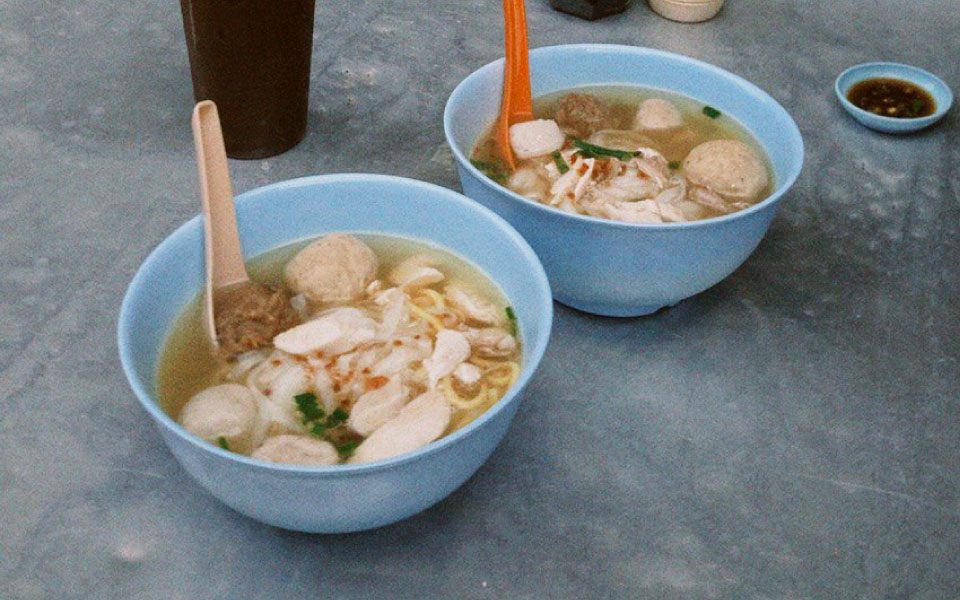
Flat rice noodles sit in a clear broth accompanied by fish balls, meat, spring onions and fried garlic or shallots. Depending on the stall, you might find slices of chicken, pork, duck, offal, fish cakes or even chicken feet.
But simplicity is exactly the point.
A great bowl of Koay Teow Th’ng doesn’t rely on heavy sauces or chilli to make an impression. The broth needs to be sweet and savoury without becoming overpowering, the rice noodles should remain silky and smooth, and freshly made fish or meat balls add the texture that brings everything together.
For generations of Penangites, this is comfort food.
It can be breakfast before work, a quick lunch, a light dinner or even supper after a night out.
And while visitors arrive in Penang searching for Char Koay Teow, Hokkien Mee and Curry Mee, Koay Teow Th’ng offers a quieter glimpse into the everyday noodle culture of the state.
What Is Koay Teow Th’ng?
Koay Teow Th’ng (粿条汤) literally describes exactly what is in the bowl.
Koay teow refers to flat rice noodles, while th’ng means soup in Penang Hokkien.
Put them together and you get “rice noodle soup”.
But that straightforward name hides a surprising amount of variation.
The basic version consists of silky flat rice noodles submerged in a clear meat-based broth. Fish balls, meatballs, sliced meat, spring onions, fried garlic or shallots and other toppings are then added.
Depending on the hawker, the soup may be based around chicken, pork, duck or a combination of ingredients.
Some stalls are famous for handmade fish balls. Others specialise in duck meat. Some add pork intestines or other offal. And along Kimberley Street, one of the most recognisable versions comes topped with braised chicken feet.
That’s why eating Koay Teow Th’ng at several stalls doesn’t necessarily feel like repeating the same meal.
Why Koay Teow Th’ng Is One of Penang’s Great Comfort Foods
Penang’s most famous hawker dishes tend to be big on flavour.
Char Koay Teow gives you wok hei, soy sauce and chilli.
Curry Mee combines coconut richness with spicy sambal.
Hokkien Mee is built around an intense prawn-and-pork broth.
Koay Teow Th’ng sits at the opposite end of the spectrum.
Its flavour is gentle.
A clear, savoury soup surrounds slippery rice noodles, while fried garlic or shallots add fragrance and fish balls provide a satisfying bounce.
Nothing needs to shout.
This is one reason Koay Teow Th’ng works at almost any time of day. It is substantial enough for breakfast or lunch but usually light enough that you don’t feel overwhelmed afterwards.
It’s also the sort of dish Penangites turn to when they want something warm and comforting rather than spicy or fried.
If you’re exploring Penang primarily through food, include at least one bowl between the heavier dishes in our Penang Street Food Guide.
What Makes a Good Koay Teow Th’ng?
Because the dish appears so simple, there isn’t much room to hide mistakes.
A Clear but Flavourful Broth
A light-coloured soup doesn’t mean a weak soup.
The broth should have enough sweetness and savouriness to carry the entire bowl without becoming excessively salty.
Good hawkers build flavour through bones, meat and long simmering rather than relying solely on seasoning.
Silky Koay Teow
The flat rice noodles should be smooth and slippery without becoming mushy.
They need enough structure to survive in hot soup while remaining delicate.
Good Fish Balls
At stalls specialising in handmade fish balls, texture becomes especially important.
They should be springy and pleasantly firm rather than floury or rubbery.
Fried Garlic or Shallots
A small amount makes a huge difference.
The aroma released as fried garlic or shallots meet the hot soup provides another layer of flavour without overwhelming the broth.
Fresh Meat and Toppings
Whether you’re eating chicken, pork or duck, the toppings should complement rather than dominate the noodles and soup.
Best Koay Teow Th’ng in Penang
Ah Boy Koay Teow Th’ng
Lebuh Clarke, 10050
George Town, Penang.
Loh Kei Duck Meat Koay Teow Th’ng

13, Jalan Perak,
10400 George Town, Penang.
Lum Lai Duck Meat Koay Teow Th’ng

Cecil Street Market Hawker Center,
Lebuh Cecil, 10300 George Town, Penang.
Pitt Street Koay Teow Th’ng

183, Lebuh Carnarvon,
10100 George Town, Penang.
113 Coffee Shop Duck Meat Koay Teow Soup

113, Lebuh Melayu,
10300 George Town, Penang.
Tiger Koay Teow Th’ng
179, Lebuh Carnarvon,
10450 George Town, Penang.
Koay Teow Soup Cintra Street
11-B, Kedai Kopi Xiao Shi, Jalan Sungai Ujong,
10100 George Town, Penang.
Fook Cheow Cafe

122I, Jalan Hutton,
10050 George Town, Penang.
Pulau Tikus Night Hawker Stall
Jalan Burma, Pulau Tikus,
10350 George Town, Penang.
Lebuh Kimberley
Lebuh Kimberly, 10450
George Town, Penang.
Soup or Dry Koay Teow Th’ng?
Despite “th’ng” literally referring to soup, some stalls also offer a dry version.
Instead of sitting in broth, the koay teow is tossed with soy-based seasoning and other sauces, while a bowl of clear soup is served separately.
The noodles therefore carry a stronger savoury flavour.
At Ah Boy, for example, diners can choose between soup and dry preparations.
If this is your first time eating Koay Teow Th’ng, start with the soup.
Then return another day and order dry.
Koay Teow Th’ng vs Koay Teow Soup: Are They the Same?
Essentially, yes.
“Koay Teow Th’ng” is simply the local Penang Hokkien way of saying rice-noodle soup.
English-language menus may write it as:
- Koay Teow Th’ng
- Koay Teow Thng
- Koay Teow Soup
- Kway Teow Soup
- Flat Rice Noodle Soup
The spelling varies because Chinese dialect words are being transliterated into English.
Koay Teow Th’ng vs Char Koay Teow
They share the same flat rice noodle, but that’s about where the similarity ends.
Koay Teow Th’ng
- Clear soup
- Light and comforting
- Fish balls, chicken, pork or duck
- Usually gently seasoned
- Common for breakfast
Char Koay Teow
- Stir-fried
- Smoky and intensely savoury
- Soy sauce and chilli
- Commonly cooked with prawns, cockles, egg and bean sprouts
- Famous for wok hei
Trying both demonstrates how versatile the humble rice noodle can be.
Our guide to the best Char Koay Teow in Penang explores the fried version in much greater detail.
What Toppings Come with Koay Teow Th’ng?
Every stall is different, but common ingredients include:
Fish Balls
Perhaps the most recognisable topping.
Handmade versions can be particularly springy and have considerably more character than commercially produced fish balls.
Meatballs
Pork or tendon balls add another texture and a deeper savoury flavour.
Sliced Pork
Lean slices of pork are common in traditional bowls.
Chicken
Some hawkers build their broth around chicken and serve sliced or braised chicken alongside the noodles.
Duck
Duck versions are particularly popular at certain established stalls and have a richer character.
Offal
Depending on the hawker, you may find liver, intestines or other traditional additions.
Chicken Feet
The Kimberley Street version is especially well known for braised chicken feet.
Fried Garlic and Shallots
These may look like garnishes, but their fragrance is essential to the finished bowl.
How to Order Koay Teow Th’ng in Penang
Ordering is generally straightforward.
Choose Your Noodles
Koay teow is the obvious choice, but some stalls may allow you to substitute or mix noodles.
Soup or Dry
Traditional soup is the best starting point.
Choose dry if you’ve eaten the soup version before and want something stronger.
Choose Your Size
Most hawker stalls offer different portion sizes.
A small bowl works particularly well if you’re doing a larger Penang breakfast crawl.
Add Extras
Depending on the stall:
- Extra fish balls
- Meatballs
- Duck
- Chicken
- Pork
- Offal
- Chicken feet
If a stall is famous for one particular ingredient, order it.
How Should You Season Koay Teow Th’ng?
Before doing anything, taste the soup.
This matters more with Koay Teow Th’ng than with many other Penang noodle dishes because the broth is deliberately delicate.
Only then decide whether it needs:
- Chilli
- Soy sauce
- Pepper
Some stalls provide their own chilli sauce specifically designed to accompany the fish balls and meat rather than to be dumped into the entire bowl.
Try dipping the toppings first.
You can always add more seasoning later.
You can’t take it back out.
When Is the Best Time to Eat Koay Teow Th’ng?
Almost anytime.
That’s one of the dish’s great advantages.
Many traditional stalls specialise in breakfast and lunch, opening early and finishing once their broth or ingredients sell out.
But evening options exist too, particularly around Kimberley Street and night hawker areas.
That means Koay Teow Th’ng can fill whichever gap remains in your Penang food itinerary.
Breakfast before sightseeing?
Koay Teow Th’ng.
Something light for lunch?
Koay Teow Th’ng.
Hungry after walking around George Town at night?
There’s probably a bowl somewhere.
Is Koay Teow Th’ng Halal?
Traditional Chinese Koay Teow Th’ng should not automatically be assumed to be halal.
Many stalls use pork bones in their broth or serve pork, pork balls and offal.
Even bowls that visually contain only chicken or fish balls may use a pork-based stock.
Halal rice-noodle soups certainly exist in Penang, but if halal status is important, check the operator’s current certification or ingredients directly.
Why Koay Teow Th’ng Deserves More Attention
Koay Teow Th’ng will probably never photograph as dramatically as Char Koay Teow.
It doesn’t arrive flaming from a wok.
It isn’t bright red like Curry Mee.
And it doesn’t have Hokkien Mee’s intense prawn aroma.
But that isn’t what the dish is trying to be.
Koay Teow Th’ng represents another side of Penang food: simple, everyday and comforting.
It relies on the quality of broth, noodles and handmade ingredients rather than aggressive seasoning.
It’s what someone might eat before work.
It’s what families have for breakfast.
It’s the bowl you crave when you want something warm without feeling overly full afterwards.
And understanding Penang’s food culture means eating these everyday dishes too — not just working through a list of the most famous hawker foods.
Frequently Asked Questions About Koay Teow Th’ng in Penang
What is Koay Teow Th’ng?
Koay Teow Th’ng is a Penang-style flat rice noodle soup served in a clear broth, commonly accompanied by fish balls, meatballs, pork, chicken or duck and aromatic garnishes.
What does Koay Teow Th’ng mean?
“Koay teow” refers to flat rice noodles, while “th’ng” means soup in Penang Hokkien.
Where can I find the best Koay Teow Th’ng in Penang?
Ah Boy on Clarke Street and Pitt Street Koay Teow Th’ng on Carnarvon Street are among the best-known traditional choices in George Town. Other versions can be found around Jalan Perak, Cecil Street, Hutton Lane, Kimberley Street and Pulau Tikus.
What is special about Pitt Street Koay Teow Th’ng?
Pitt Street is particularly known for its handmade eel fish balls. Despite the name, the stall is now located on Carnarvon Street rather than Pitt Street.
Can I get dry Koay Teow Th’ng?
Yes. Some stalls, including Ah Boy, offer both soup and dry preparations.
Is Koay Teow Th’ng the same as Kway Teow Soup?
Yes. Spellings differ, but both generally refer to flat rice noodles served in soup.
Is Koay Teow Th’ng spicy?
Usually not. The broth is generally light and savoury, with chilli added separately according to taste.
Is Koay Teow Th’ng eaten for breakfast?
Very commonly. Many traditional stalls operate during breakfast and lunch, although evening versions are available as well.
Is Koay Teow Th’ng halal?
Traditional Chinese versions may contain pork or use pork bones in the broth and should not automatically be assumed to be halal.
Koay Teow Th’ng isn’t the Penang dish that demands your attention.
It earns it quietly.
A clear broth. Silky rice noodles. A few springy fish balls. Slices of meat. Fried garlic. Spring onions.
That’s essentially it.
But when every component is done properly, the result is one of Penang’s most satisfying comfort foods.
Start with Ah Boy to understand the classic style. Visit Pitt Street for the handmade eel fish balls. Try duck Koay Teow Th’ng around Jalan Perak or Cecil Street. Then head to Kimberley Street after dark and see how braised chicken feet completely change the character of the bowl.
Eventually, venture beyond central George Town and discover the neighbourhood versions Penangites have been eating for generations.
Because exploring Penang food isn’t only about finding the boldest, spiciest or most famous dish.
Sometimes, it’s simply about sitting down in a coffee shop with a bowl of hot noodle soup.
Continue your food journey with our guides to the best Hokkien Mee in Penang, best Curry Mee in Penang, best Char Koay Teow in Penang, best Char Koay Kak in Penang, best Chee Cheong Fun in Penang and best breakfast in Penang.
For an overview of everything worth eating, start with our Ultimate Penang Food Guide and Penang Street Food Guide.