During the seventh month of the Chinese lunar calendar, neighbourhoods across Penang undergo a striking transformation. Temporary altars appear beside roads, incense fills the air, elaborate offerings are displayed, and brightly illuminated stages host Chinese opera and getai performances late into the evening.
These activities form part of the Hungry Ghost Festival, one of the most distinctive celebrations featured in Penang’s annual calendar of events and festivals. Locally associated with Phor Thor or Por Tor celebrations, the festival brings together spiritual beliefs, ancestor remembrance, communal worship and public entertainment.
For visitors, it offers a fascinating glimpse into the living traditions of Penang’s Chinese communities. However, it is important to remember that this is not merely a cultural show or tourist attraction. Many of the altars, ceremonies and offerings encountered around Penang remain part of deeply respected religious and community practices.
What Is the Hungry Ghost Festival?
The Hungry Ghost Festival is traditionally observed during the seventh month of the Chinese lunar calendar, commonly called Ghost Month.
According to Chinese folk belief, the boundary between the human and spiritual realms opens during this period. Deceased ancestors may return to visit their families, while wandering spirits without descendants to care for them are believed to roam the earthly world in search of food, comfort and entertainment.
Families, businesses, temples and neighbourhood associations prepare offerings to honour the deceased and appease wandering spirits. These may include cooked dishes, fruit, tea, incense, candles, joss paper and papier-mâché representations of material possessions.
The principal festival day falls on the fifteenth day of the seventh lunar month, although ceremonies and community celebrations may take place throughout the entire month.
The observance incorporates elements of Taoism, Buddhism, ancestor veneration and Chinese folk religion. Customs can therefore differ between dialect groups, temples, families and individual neighbourhoods.
What Is Phor Thor in Penang?
In Penang, communal Hungry Ghost celebrations are frequently known as Phor Thor, although the English spelling may also appear as Por Tor or Poh Toh.
Phor Thor generally refers to communal rites intended to honour and provide for wandering spirits. Instead of only making offerings to their own ancestors, participating communities collectively prepare food, prayers and entertainment for spirits who may have no living descendants to remember them.
These celebrations also serve an important social function. Traders, residents, temples and local associations contribute money or resources, organise performances and gather around shared ceremonial spaces.
Consequently, Phor Thor is both a spiritual observance and an expression of neighbourhood identity.
Why Is the Hungry Ghost Festival Important in Penang?
Penang’s long history as a trading port attracted Chinese migrants from different regions, including Hokkien, Cantonese, Teochew, Hakka and Hainanese communities.
Many arrived without extensive family networks and depended on clan associations, temples and trade organisations for employment, accommodation and social support. Historic institutions such as Cheah Kongsi illustrate how these organisations helped Chinese immigrants establish new lives while maintaining ancestral and religious traditions.
Some early migrants died far from their ancestral homes or without descendants who could perform customary rites for them. Communal worship provided a way to remember and care for these otherwise unattended spirits.
Over time, the observance became firmly rooted in Penang’s temples, markets, clan communities and neighbourhood associations. It remains especially visible because religious rituals are frequently conducted in public spaces rather than entirely inside homes or temples.
The festival therefore reveals more than beliefs about the spiritual world. It also reflects migration, kinship, mutual assistance and the development of Chinese society within George Town’s historic port city.
Hungry Ghost Month and Hungry Ghost Festival: Are They the Same?
Although the terms are often used interchangeably, they have slightly different meanings.
Hungry Ghost Month refers to the entire seventh month of the Chinese lunar calendar. Throughout this period, families and communities may burn incense, prepare offerings and observe traditional precautions.
The Hungry Ghost Festival usually refers more specifically to the fifteenth day of that month, regarded as its ceremonial high point. In practice, Penang’s community events are not limited to this one day and may be scheduled at different times throughout the month.
Hungry Ghost Festival Traditions in Penang
Food and Incense Offerings
Tables filled with rice, noodles, fruit, cakes, tea and other dishes are commonly placed near temples, businesses or temporary roadside altars.
The offerings may be intended for ancestors, deities or wandering spirits, depending on the ceremony. Incense and candles are lit alongside the food as prayers are conducted.
Visitors should not touch, rearrange or take anything from these tables, even when the food appears unattended.
Burning Joss Paper
Joss paper is burned as a symbolic offering to the spiritual world. Traditional paper money may be accompanied by elaborate paper objects representing clothes, houses, vehicles, electronic devices and other possessions.
These items are symbolically sent to the deceased through fire, allowing them to receive and use the offerings in the afterlife.
Burning ceremonies can produce considerable smoke and heat. Visitors should observe from a respectful distance without obstructing worshippers or entering the designated burning area.
Temporary Altars and Prayer Tents
During the festival, temporary structures may be erected near markets, shop rows and residential communities. These spaces can contain deity statues, incense urns, ceremonial flags and long tables covered with offerings.
They are functioning religious spaces rather than festival decorations. Ask for permission before photographing people who are praying or handling ritual objects.
Travellers interested in understanding the wider spiritual landscape can also explore Penang’s Chinese temples and sacred sites, many of which continue to serve as active centres for religious ceremonies and community festivals.
The Da Shi Ye Effigy
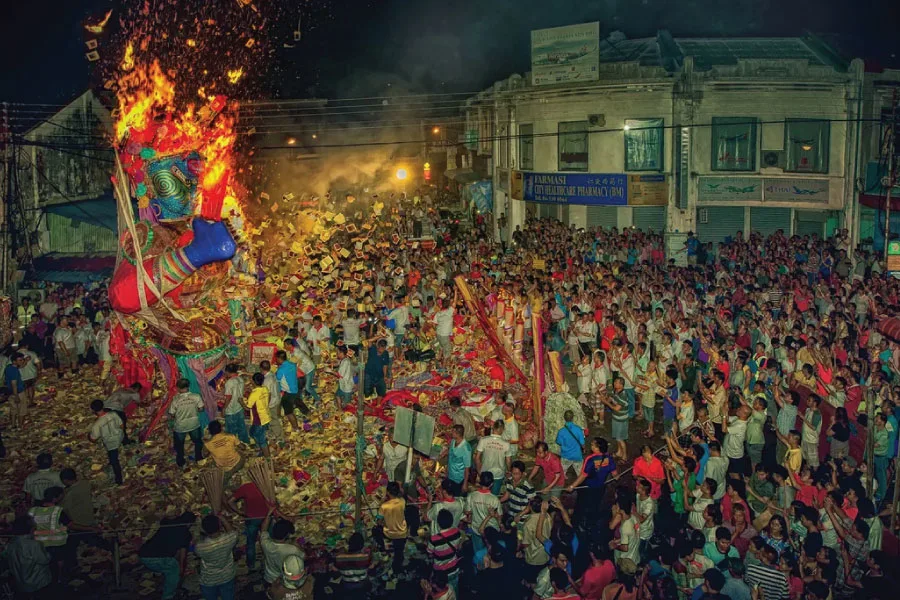
One of the most recognisable figures associated with Penang’s Phor Thor celebrations is Da Shi Ye, often represented by an imposing papier-mâché effigy.
Da Shi Ye is regarded as a guardian who maintains order among wandering spirits during the seventh lunar month. The effigy commonly occupies a prominent position overlooking an altar or ceremonial area.
At the conclusion of certain celebrations, the effigy and other paper offerings may be ceremonially burned, symbolising the end of that community’s observance and the return of the spirits to the spiritual realm.
Chinese Opera and Puppet Performances
Traditional Chinese opera, sometimes called wayang by local communities, has long been performed during Hungry Ghost Month.
The elaborate costumes, painted faces, stylised gestures and live music make these performances visually captivating, even for audiences who do not understand the dialect being used. However, the performances are traditionally presented for spiritual guests as well as human spectators.
Chinese puppet theatre may also appear in certain neighbourhood celebrations, although it is less commonly encountered than it once was.
Getai Performances
Getai, which means “song stage”, represents the festival’s more contemporary entertainment tradition.
Performances may feature singers, dancers, comedians and hosts speaking in Mandarin, Hokkien or other local languages. Bright lighting, colourful costumes and powerful sound systems create a lively contrast with the nearby altars and prayer ceremonies.
Getai performances are usually free to watch. Nevertheless, avoid occupying the empty seats at the front of the stage. These are traditionally reserved for the spirits.
Community Dinners and Auctions
Some Phor Thor committees organise communal dinners and auctions to raise funds for temples, associations, charitable activities or future celebrations.
Auspicious goods, ceremonial items and sponsored products may attract spirited bidding. Beyond fundraising, these events strengthen relationships among traders, residents and members of local community organisations.
Where Can You Experience the Festival in Penang?
The Hungry Ghost Festival does not have one permanent venue or a single island-wide programme. Celebrations are organised independently by temples, markets, traders and neighbourhood committees.
Activities may be found around:
- George Town’s traditional commercial and residential quarters
- Jelutong
- Air Itam
- Pulau Tikus
- Tanjung Tokong
- Market areas and hawker centres
- Chinese temples and neighbourhood associations
- Communities across Seberang Perai
The scale and schedule vary from year to year. A location with an elaborate stage one year may organise a smaller ceremony the next.
Visitors unfamiliar with these areas can consult our guide to Penang’s neighbourhoods to understand the character, location and cultural identity of places such as George Town, Air Itam, Jelutong and Pulau Tikus.
Look for temporary performance stages, prayer flags, large altar tents and notices displayed around markets or temples. Local residents and stallholders may also know when their neighbourhood’s getai or Chinese opera performances will take place.
How to Watch a Getai Respectfully
Visitors are generally welcome to watch public getai and Chinese opera performances. Observing a few basic courtesies will make the experience more respectful:
- Do not sit in the first row when seats have deliberately been left empty.
- Keep away from active prayer and paper-burning areas, unless you are a part of the prayers and ceremonial proceedings.
- Do not move chairs solely to obtain a better photograph.
- Ask before taking close-up photographs of worshippers.
- Keep conversations quiet during ceremonial proceedings.
- Follow instructions given by organisers or temple volunteers.
- Never touch food, incense or ritual objects displayed as offerings.
A public performance may look informal, but it remains connected to a religious observance.
The same principle applies when visiting Penang’s temples, mosques and other active places of worship. Our guide to Penang’s multi-faith heritage buildings provides further advice for exploring these culturally important sites respectfully.
Hungry Ghost Festival Taboos and Superstitions
Ghost Month is surrounded by traditional taboos intended to prevent people from attracting or offending wandering spirits.
Depending on family beliefs, people may avoid swimming at night, staying outside too late, stepping over offerings, hanging clothes outdoors overnight, moving house, beginning a major business venture or holding a wedding during the seventh lunar month.
Other customary warnings include avoiding whistling at night, picking up unfamiliar objects from the road and placing chopsticks upright in a bowl of rice.
Not every Chinese family follows every taboo, and interpretations vary considerably between generations and communities. They are best understood as folk beliefs passed down through families rather than universal rules.
Our separate guide explains the commonly observed things you shouldn’t do during the Hungry Ghost Festival and the traditional beliefs behind them.
Is the Hungry Ghost Festival Like Halloween?
Despite the English name and its association with spirits, the Hungry Ghost Festival is not the Chinese equivalent of Halloween.
Halloween is widely associated with costumes, trick-or-treating and recreational activities. The Hungry Ghost Festival is centred on remembrance, religious rites, offerings, spiritual compassion and the responsibilities of the living towards the deceased.
Getai and opera performances can create a carnival-like atmosphere, but their original purpose is to entertain spiritual guests and support communal worship. Describing the celebration merely as “Chinese Halloween” overlooks much of its religious and cultural significance.
Tips for Visitors and Photographers
Visit After Sunset
Getai and Chinese opera performances generally become livelier after dark. Altars and stages are also illuminated, creating the festival’s most distinctive atmosphere.
Arrive before the performance begins if you want to observe the preparations and find an appropriate place to stand or sit.
Observe Before Photographing
Spend a few moments understanding what is happening before raising your camera. Rituals that appear visually interesting may be private or solemn for the people participating.
Wide photographs of a public stage are generally less intrusive than close-up images of worshippers performing prayers.
Stay Clear of Roadside Offerings
Offerings can be placed near kerbs, trees, junctions and shop entrances. Watch where you walk and avoid stepping on joss paper, ash, candles or incense.
Expect Smoke and Loud Music
Paper-burning ceremonies can generate smoke, while getai sound systems can be extremely loud. Visitors sensitive to either should maintain a comfortable distance.
Do Not Treat Offerings as Props
Never touch an altar, pose beside a religious effigy without permission or rearrange ceremonial items for photographs. These objects retain religious meaning even when the surrounding event feels informal.
Check Locally for Programmes
Because celebrations are decentralised, schedules can be difficult to find far in advance. Community social media pages, temple notices and conversations with neighbourhood traders are often useful sources of information.
If you are visiting several cultural sites within central George Town, the Penang Free CAT Bus connects many parts of the heritage area. However, individual Phor Thor events may still require a short walk or ride-hailing trip.
Other Cultural Experiences to Explore
The Hungry Ghost Festival is only one expression of Penang’s diverse living heritage. Visitors can also explore historic clan houses, neighbourhood temples and traditional waterfront communities to understand how migration and community networks shaped the state.
Within George Town, places such as Cheah Kongsi demonstrate the importance of ancestral worship and clan identity, while the Street of Harmony brings several of Penang’s major religious traditions together along one historic route.
These sites provide valuable context for understanding why festivals continue to occupy such an important place in Penang’s cultural life.
Frequently Asked Questions
When is the Hungry Ghost Festival celebrated?
It is observed during the seventh month of the Chinese lunar calendar. The principal festival day falls on the fifteenth day, although ceremonies and performances may continue throughout the month.
What is the Hungry Ghost Festival called in Penang?
Hungry Ghost Month is closely associated with communal Phor Thor celebrations in Penang. English spellings vary and may include Por Tor and Poh Toh.
Can tourists attend Hungry Ghost Festival events?
Public getai shows, Chinese opera performances and neighbourhood celebrations are generally open to spectators. Visitors should remain respectful because these events are connected to active religious observances.
Why are the front-row seats left empty?
The empty seats are traditionally reserved for wandering spirits, who are considered the performance’s honoured guests. Human spectators should sit farther back unless organisers indicate otherwise.
Why are food offerings placed beside roads?
The food is offered to wandering spirits as an act of compassion and appeasement. It should not be touched, eaten or removed by passers-by.
Is the festival celebrated on only one day?
No. The fifteenth day is the main festival day, but rituals, offerings and performances take place at different times throughout the seventh lunar month.
Is Hungry Ghost Month only a Taoist tradition?
Present-day practices draw from Taoism, Buddhism, ancestor veneration and Chinese folk religion. The exact combination of beliefs and rituals varies between communities.
Where is the best place to see the Hungry Ghost Festival in Penang?
There is no single official venue. George Town, Air Itam, Jelutong, Pulau Tikus and other established Chinese neighbourhoods may host ceremonies and performances, but locations and schedules can change annually.
Do I need a ticket to watch getai?
Most neighbourhood getai and Chinese opera performances are free to watch. Some associated dinners or fundraising events may require invitations, reservations or purchased tables.
Experiencing a Living Penang Tradition
The Hungry Ghost Festival is one of the most atmospheric times to experience Penang’s living cultural heritage. Its altars, offerings, operas and getai stages reveal traditions that continue to connect spiritual beliefs with everyday neighbourhood life.
Yet the festival is about more than ghosts or superstition. At its heart are remembrance, generosity and communal responsibility—the belief that even spirits without families should not be forgotten.
Visitors who approach the celebration with curiosity and respect will encounter a side of Penang that extends beyond its famous food and architecture: a living tradition maintained by generations of communities across both the island and mainland. For more celebrations worth experiencing throughout the year, continue with our complete guide to the major events and festivals in Penang.