Amid the temples, mosques, clan houses and colonial buildings of historic George Town stands an elegant white church that has witnessed more than two centuries of Penang’s history.
St George’s Church, commonly known as St George’s Anglican Church, was completed in 1818 and is recognised as the oldest Anglican church in Southeast Asia. With its distinctive white façade, classical columns and soaring octagonal steeple, the church remains one of the most recognisable landmarks within the George Town UNESCO World Heritage Site.
But St George’s Church is more than an architectural attraction. It remains an active place of worship and represents an important chapter in the development of colonial Penang.
Located along Lebuh Farquhar, almost opposite the Penang State Museum, the church is also an excellent starting point for exploring George Town’s famous Street of Harmony, where Anglican, Taoist, Hindu and Islamic places of worship stand within walking distance of one another.
Here is everything you need to know about the history, architecture and significance of St George’s Church before your visit.
What is St George’s Church?
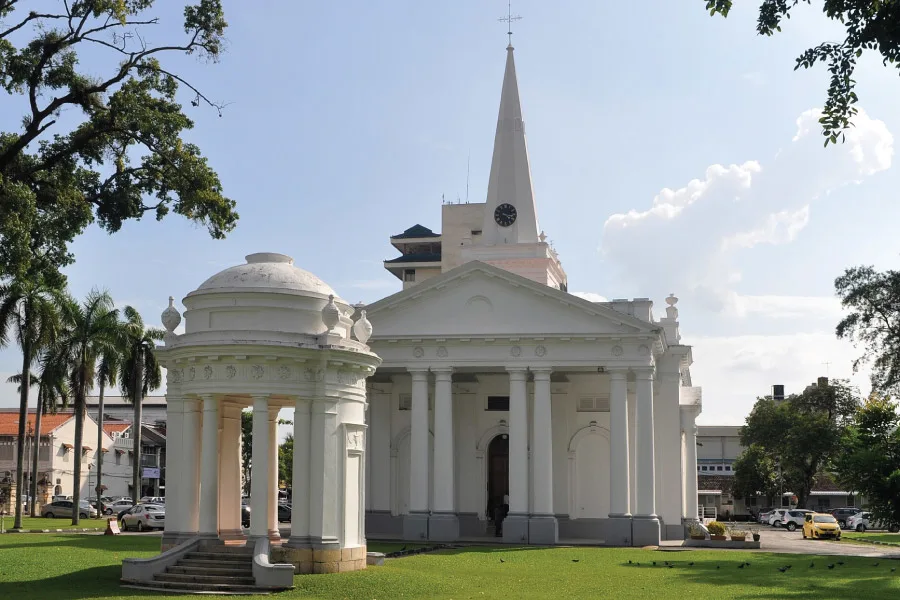
St George’s Church is an Anglican church located at 1 Lebuh Farquhar in George Town, Penang.
Construction began in 1817 during the period when Penang was administered by the British East India Company, and the building was completed the following year. The first service inside the new church took place on Christmas Day 1818.
Before the church existed, Anglican services in early George Town were held at places including Government House and the Court House. Despite the British presence in Penang since the late 18th century, Anglicans were actually among the last of George Town’s major religious communities to construct a permanent place of worship.
More than 200 years later, St George’s continues to function as an active Anglican church while also being one of George Town’s most significant heritage buildings.
The History of St George’s Church
To understand St George’s Church, it helps to look back at the development of early colonial Penang.
The British East India Company established its settlement on Penang Island in 1786. As George Town developed into an increasingly important trading port, its European population grew, creating demand for a permanent Anglican church.
Plans for the church took years to materialise. Questions surrounding funding, the future location of George Town and even the continuation of the East India Company’s trading charter contributed to delays. Eventually, the East India Company financed construction of the church.
Construction began in 1817, and the completed church opened for worship on Christmas Day the following year.
The Bishop of Calcutta, Rt Rev Thomas Fanshaw Middleton, subsequently consecrated St George’s Church in 1819.
Today, it is regarded as the oldest surviving Anglican church in Southeast Asia.
Who Designed St George’s Church?
The architectural history of St George’s Church has several important figures associated with it.
Historical research identifies James Lilliman Caldwell of the Madras Engineers with the design, while Lieutenant Robert Smith of the Bengal Engineers supervised or carried out its construction.
Smith was more than an engineer. He was also an accomplished artist whose paintings provide valuable visual records of early Penang. Some of his works can be found within the collection of the nearby Penang State Museum.
The church was modelled on ecclesiastical architecture associated with British India, illustrating the close administrative and cultural connections that existed between Penang and India during the East India Company period.
Architecture of St George’s Church
One of the reasons St George’s Church remains such a striking George Town landmark is its relatively restrained architecture.
Rather than elaborate decoration, the building relies on symmetry, proportion and classical architectural elements.
Its style has commonly been described as Georgian Palladian or Neoclassical, incorporating features such as:
- A symmetrical white façade
- Classical columns
- Triangular pediments
- A prominent entrance portico
- Tall arched windows
- An octagonal steeple
- A simple, spacious interior
- Extensive landscaped grounds
The combination gives the church a very different appearance from the colourful Chinese and Hindu temples found only a few streets away.
That contrast is one reason walking through this part of George Town is so fascinating.
Why Does St George’s Church Have a Pitched Roof?
The church you see today isn’t exactly the building that opened in 1818.
Its original design incorporated an Indian-style flat roof, but this proved poorly suited to Penang’s heavy tropical rainfall. Water leakage became an almost immediate problem.
After repeated attempts to address the issue, a pitched roof was eventually added to the central portion of the building in 1864.
It is a simple but fascinating example of how European and British Indian architectural ideas had to be adapted to Penang’s tropical environment.
The Francis Light Memorial
Standing prominently on the church grounds is a distinctive domed pavilion commonly known as the Francis Light Memorial.
Captain Francis Light is closely associated with the establishment of the British settlement on Penang Island in 1786.
The memorial takes the form of a small classical rotunda supported by columns, creating one of the most recognisable features of the church grounds.
It was erected by public subscription in 1824, several decades after Light’s death in 1794.
Underneath the dome is a memorial plaque dedicated to Light.
The monument is now recognised as a Category I heritage monument within George Town.
Visitors sometimes mistake the pavilion for part of the original church architecture, but it is actually a separate memorial constructed several years after the church opened.
Is Francis Light Buried at St George’s Church?
No.
Despite the prominent memorial within the church grounds, Francis Light is not buried at St George’s Church.
His grave can instead be found at the historic Northam Road Protestant Cemetery along Jalan Sultan Ahmad Shah.
The cemetery was established soon after the British settlement was founded and contains the graves of many figures associated with early colonial Penang, including governors, East India Company officials and merchants.
For visitors particularly interested in Penang’s early colonial history, visiting both St George’s Church and the Protestant Cemetery provides a much broader picture of the people who shaped the settlement.
St George’s Church During World War II
One of the most dramatic chapters in the church’s history occurred during the Second World War.
During the Japanese air raids on George Town in December 1941, a bomb severely damaged St George’s Church.
The destruction did not end with the bombing.
Looting that followed caused even greater losses. Many of the marble memorials that once lined the church walls disappeared, along with its marble flooring, pipe organ and much of its furniture.
Of the numerous memorial tablets once found within the church and grounds, only a small number survived the war.
The damage represented a significant loss of historical material connected to Penang’s early European community.
Restoration and Reopening After the War
Following the end of the Japanese Occupation, work began to restore the damaged church.
St George’s eventually reopened in 1948, allowing worship to resume several years after the destruction.
Further conservation work has taken place over subsequent decades.
On 4 April 1996, the church and its approximately two-acre grounds were gazetted as a historical site. It was subsequently listed among Malaysia’s National Heritage Treasures in 2007. A major restoration project undertaken in 2010 was completed the following year.
George Town World Heritage Incorporated also classifies St George’s Church as a Category I heritage building, reflecting its importance to the Outstanding Universal Value of the George Town UNESCO World Heritage Site.
Things to See at St George’s Church
Although it isn’t a large attraction, there are several details worth slowing down to appreciate.
The Main Church
The brilliant white church building is naturally the centrepiece.
Walk around the exterior to appreciate the symmetry of the façade, classical columns, windows and octagonal steeple from different perspectives.
If the interior is accessible during your visit, remember that this remains an active place of worship rather than simply a historical attraction.
The Francis Light Memorial
Don’t miss the domed memorial standing on the church lawn.
Its architectural form makes it a particularly attractive photography subject, while its connection with Francis Light adds another historical layer to the site.
The Church Grounds
The spacious lawn surrounding St George’s provides an unusual sense of openness in the middle of densely built historic George Town.
Some of the mature trees around the grounds also contribute significantly to the atmosphere and provide welcome shade from Penang’s heat.
Surviving Memorials
Look for surviving memorial plaques connected to members of George Town’s early European community.
Many original memorials were lost during the Second World War, making those that remain particularly valuable historical records.
St George’s Church and George Town’s Street of Harmony
St George’s Church becomes even more meaningful when considered within its surrounding neighbourhood.
It stands at the northern end of an extraordinary concentration of religious buildings stretching along and around Jalan Masjid Kapitan Keling, commonly called George Town’s Street of Harmony.
Within a relatively short walk, you’ll encounter places of worship associated with several different faiths and communities.
Goddess of Mercy Temple
Continue south from St George’s Church and you’ll reach the historic Goddess of Mercy Temple, one of George Town’s most important Chinese temples.
The contrast between the Neoclassical Anglican church and traditional Chinese temple architecture illustrates how different communities developed alongside one another in colonial George Town.
Sri Mahamariamman Temple
Continue into Little India to find Sri Mahamariamman Temple, Penang’s oldest Hindu temple.
Its colourful sculptural tower provides another dramatic architectural contrast with St George’s Church.
Kapitan Keling Mosque
Further along the same street stands the magnificent Kapitan Keling Mosque, historically associated with George Town’s Indian Muslim community.
Together, these landmarks help explain why this corridor has become such a powerful representation of Penang’s multicultural identity.
Best Time to Visit St George’s Church
The church exterior and grounds are particularly attractive during the morning.
Arriving earlier offers:
- Cooler temperatures
- Softer photography light
- Quieter surroundings
- An easier walk through the surrounding heritage district
Late afternoon can also be beautiful, especially if you’re continuing towards the Esplanade and waterfront around sunset.
Because St George’s remains an active church, access to the interior can be affected by services, religious events and church activities.
Always behave respectfully and avoid disrupting worship.
How Long Should You Spend at St George’s Church?
For the church alone, around 20 to 30 minutes is sufficient for most visitors.
However, I’d recommend allowing two to three hours for the wider area.
St George’s is best experienced as part of a walking route incorporating the Penang State Museum, Street of Harmony, Little India and the historic waterfront rather than as an isolated attraction.
How to Get to St George’s Church
St George’s Church is located at:
1 Lebuh Farquhar
10200 George Town
Penang
By Foot
Walking is the best option if you’re already exploring the George Town UNESCO World Heritage Site.
The church is within easy walking distance of the Penang State Museum, Little India, Esplanade and several other major heritage attractions.
By Bus
Rapid Penang services operate throughout central George Town, while the free CAT Bus can also be useful for travelling around the heritage zone.
See our Penang Public Transport Guide for more information about getting around the island without a car.
By Grab
Grab is convenient when travelling from areas such as Gurney Drive, Pulau Tikus, Air Itam or elsewhere on Penang Island.
Things to Do Near St George’s Church
St George’s location makes it particularly easy to combine with other attractions.
Penang State Museum
Almost directly nearby, the newly reopened Penang State Museum provides one of the best introductions to the history and communities of Penang.
Allow around 1.5 to two hours if you’re planning a proper museum visit.
Little India
Walk south towards Little India to experience colourful textile shops, spice merchants, Indian restaurants, traditional businesses and religious landmarks.
Esplanade and Padang Kota Lama
Walk towards the waterfront and you’ll reach Padang Kota Lama, or the Esplanade, one of George Town’s most important civic spaces.
Penang City Hall and Town Hall
Facing the Esplanade are Penang City Hall and the historic Town Hall, two impressive examples of colonial civic architecture.
Fort Cornwallis
Continue towards Fort Cornwallis, which traces its origins to the establishment of the British settlement on Penang Island in 1786.
Its history connects particularly well with St George’s Church and the Francis Light Memorial.
Queen Victoria Memorial Clock Tower
Near Fort Cornwallis stands the Queen Victoria Memorial Clock Tower, another landmark that reveals the relationship between colonial Penang and the wealthy local communities who contributed to the development of George Town.
Photography Tips
St George’s Church is one of George Town’s most photogenic colonial buildings.
Try photographing:
- The main façade framed by surrounding trees
- The octagonal steeple against the sky
- The Francis Light Memorial in the foreground
- The church from across Lebuh Farquhar
- Architectural details around the portico
- The church during softer morning or late-afternoon light
The white façade can appear particularly bright under Penang’s midday sun, so morning and late afternoon generally provide more balanced photographs.
Visitor Etiquette
Remember that St George’s is first and foremost a functioning church.
When visiting:
- Dress respectfully.
- Keep conversations quiet inside.
- Don’t interrupt services or prayers.
- Ask before photographing people.
- Avoid entering restricted areas.
- Follow any photography instructions displayed by the church.
- Treat memorials and historic features carefully.
A little consideration helps keep heritage places such as St George’s accessible to visitors while respecting the communities that continue to use them.
Frequently Asked Questions
Is St George’s Church the oldest church in Penang?
St George’s is the oldest Anglican church in Southeast Asia, completed in 1818. George Town does, however, have an older Catholic history; the Church of the Assumption traces its congregation to an earlier period.
When was St George’s Church built?
Construction began in 1817, and the church was completed in 1818. Its first service took place on Christmas Day that year.
Who built St George’s Church?
The church was financed by the British East India Company. Historical records associate James Lilliman Caldwell with its design and Lieutenant Robert Smith with its construction.
Is Francis Light buried at St George’s Church?
No. The structure on the church lawn is the Francis Light Memorial. His actual grave is located at the Northam Road Protestant Cemetery.
Was St George’s Church damaged during World War II?
Yes. The church was severely damaged during Japanese bombing in December 1941, while subsequent looting resulted in the loss of many furnishings and memorials. It was restored and reopened in 1948.
Can tourists enter St George’s Church?
Visitors may be able to enter outside worship and church activities, but access can vary. Remember that it remains an active Anglican church, so visitors should respect services and any access restrictions.
How long should I spend at St George’s Church?
Around 20 to 30 minutes is sufficient for the church and grounds. Allow several hours if combining it with the Penang State Museum, Street of Harmony and nearby waterfront attractions.
Is St George’s Church worth visiting?
Yes, particularly for travellers interested in history, architecture and George Town’s multicultural heritage. Its proximity to the Penang State Museum, Street of Harmony and colonial waterfront makes it very easy to incorporate into a walking itinerary.
St George’s Anglican Church may appear simple compared with some of George Town’s more elaborate temples and clan houses, but its understated architecture conceals more than two centuries of history.
Built during the British East India Company period, altered to cope with Penang’s tropical climate, devastated during the Second World War and subsequently restored, the church has survived enormous changes in the city around it.
Its location makes the story even more compelling.
Walk a few minutes from its white Neoclassical façade and you’ll encounter a Chinese temple, Hindu temple, mosque, colonial civic buildings, Little India and the historic waterfront. Few places demonstrate George Town’s layered multicultural history quite so clearly.
For the best experience, begin at the newly reopened Penang State Museum, visit St George’s Church, and then continue on foot along the Street of Harmony. What might initially appear to be several unrelated historic attractions soon begins to reveal itself as one interconnected story of George Town.