Standing prominently at the edge of George Town’s historic waterfront, the Queen Victoria Memorial Clock Tower is one of Penang’s most recognisable colonial-era landmarks. Also known as the Jubilee Clock Tower, the elegant white structure has watched over the junction of Light Street, Beach Street and King Edward Place for more than a century.
Its appearance may suggest a straightforward British colonial monument, but its story is more interesting. The tower was actually a gift from wealthy local Chinese businessman Cheah Chen Eok, commissioned to commemorate Queen Victoria’s Diamond Jubilee in 1897.
Today, the clock tower makes an easy stop while exploring the historic waterfront of the George Town UNESCO World Heritage Site. With Fort Cornwallis, the Esplanade, City Hall, Town Hall and the waterfront all nearby, it can be incorporated into a walking tour of some of George Town’s most important historic landmarks.
What is the Queen Victoria Memorial Clock Tower?
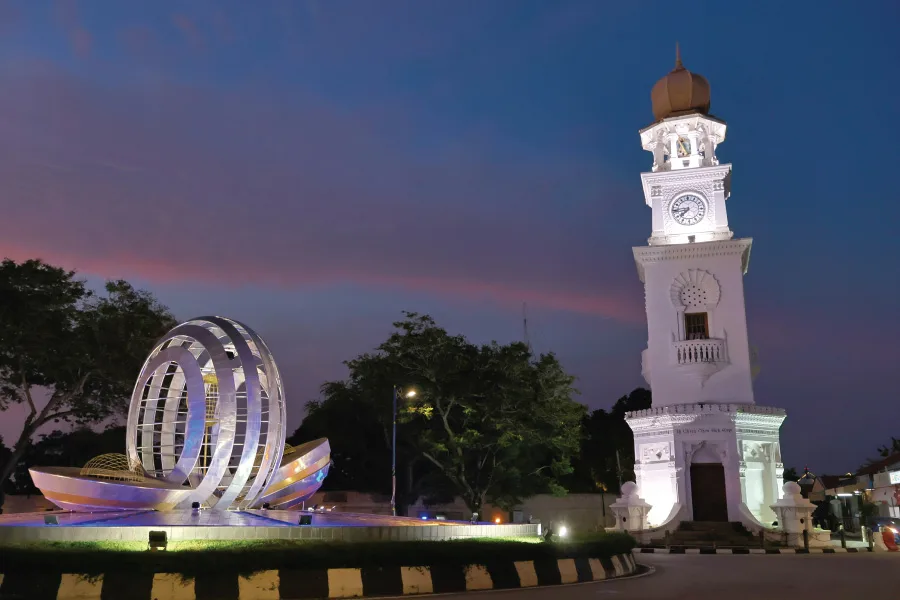
The Queen Victoria Memorial Clock Tower is a historic clock tower erected to commemorate the Diamond Jubilee of Queen Victoria, marking 60 years of her reign from 1837 to 1897.
Penang millionaire Cheah Chen Eok offered to fund the monument, and the tower was eventually presented to George Town in 1902.
One of its most famous design details is its symbolic height. From ground level to the centre of the clock, the tower measures 60 feet, with each foot representing one year of Queen Victoria’s reign at the time of her Diamond Jubilee. The complete structure rises approximately 97 feet to the top of its cupola.
More than 120 years later, it remains an important feature of the George Town cityscape.
The History of the Queen Victoria Memorial Clock Tower
The story of the clock tower began in 1897, when Queen Victoria celebrated the 60th year of her reign.
Penang’s Municipal Commissioners considered ways of commemorating the occasion, and Cheah Chen Eok proposed funding a clock tower and fountain. A design competition was subsequently organised, with municipal engineer Robert Peirce producing the winning design.
Construction did not begin immediately. Questions surrounding the design, location and rising costs delayed the project, and work eventually commenced in 1900. Construction was supervised by Barnett and Stark together with local contractors.
The completed clock tower was officially opened in July 1902.
There was, however, one historical irony: Queen Victoria never saw the completed memorial. She died in January 1901, more than a year before the tower was formally opened.
Who Was Cheah Chen Eok?
The clock tower also tells the story of Cheah Chen Eok, one of the wealthy businessmen of colonial-era Penang.
Born in Penang in 1852, Cheah established the mercantile firm Chen Eok & Co. in 1876 and accumulated considerable wealth through his business interests. He eventually became involved in the lucrative opium and spirit monopolies of the Straits Settlements.
His decision to finance the Jubilee Clock Tower illustrates the role that wealthy Asian merchants played in shaping colonial George Town. The city was not simply built by British administrators; Chinese, Indian, Malay, Arab, Armenian and other communities all contributed to its commercial, architectural and civic development.
You can explore another side of Penang’s Chinese community history at Cheah Kongsi, one of George Town’s historic clan houses, or visit the nearby Clan Jetties, where waterfront communities established by Chinese immigrants survive to this day.
Why is the Clock Tower 60 Feet Tall?
The tower’s dimensions contain deliberate symbolism.
Cheah Chen Eok wanted the clock to stand 60 feet from ground level to the centre of the clock face, representing the 60 years of Queen Victoria’s reign celebrated during her Diamond Jubilee in 1897.
However, you’ll sometimes encounter apparently conflicting descriptions of its height.
The familiar “60-foot clock tower” measurement refers to the height up to the centre of the clock. When measured all the way to the top of the cupola, the structure reaches approximately 97 feet, or around 30 metres.
It is a small architectural detail that makes the landmark much more meaningful once you know its story.
Architecture of the Queen Victoria Memorial Clock Tower
The Queen Victoria Memorial Clock Tower is particularly distinctive because it doesn’t resemble a conventional British Victorian clock tower.
Its design incorporates Indo-Saracenic influences, a style that became prominent in British territories during the late 19th century and combined European architectural ideas with Islamic and South Asian decorative elements.
Look closely and you’ll notice:
- An octagonal lower section
- Decorative arches and mouldings
- Columns surrounding the clock faces
- Ornamental details around the façade
- A belfry above the clock
- A domed cupola crowning the structure
The original design also incorporated water features around its base. Lion heads were designed to discharge water into basins, while a circular basin and drinking trough surrounded the tower.
These details make the monument considerably more elaborate than it might appear when simply passing it in traffic.
The Clock and Bells
The clock itself was one of the few major components that was not produced locally. It was brought from Europe, while most of the tower’s construction materials and workmanship were sourced locally.
Above the clock was a belfry containing five bells, which historically chimed the Westminster quarters. The clock windows were made from opal glass and were originally illuminated at night using acetylene.
These details offer a glimpse into how impressive the clock tower would have appeared to residents of George Town at the beginning of the 20th century.
Why Does the Penang Clock Tower Lean?
Look carefully at the Queen Victoria Memorial Clock Tower and you may notice something unusual: it isn’t completely straight.
The slight lean is generally attributed to damage suffered during the Second World War.
Japanese bombing of Penang in December 1941 damaged the tower and destroyed or damaged numerous buildings around George Town’s waterfront. Further Allied bombing towards the end of the war contributed to the damage, leaving the tower with its slight tilt.
The clock and chimes were repaired following the Japanese Occupation, allowing the landmark to continue keeping time over George Town.
Its slight lean has since become part of the tower’s character—and a physical reminder of the destruction Penang experienced during the war.
Visiting the Queen Victoria Memorial Clock Tower
Unlike museums or temples, the clock tower isn’t an attraction that requires a lengthy visit.
The monument is primarily viewed from the outside, and Penang’s official heritage map lists it as an external-viewing attraction.
Most travellers only need around 10 to 20 minutes to appreciate the tower and take photographs. However, its location makes it much more worthwhile as part of a walking route through George Town’s historic civic and waterfront precinct.
Best Time to Visit
The clock tower can be viewed at any time of day, but the experience changes depending on when you visit.
Early morning is particularly pleasant if you’re walking around George Town, with cooler temperatures and generally quieter streets.
Late afternoon offers warmer light for photography and makes it easy to continue towards the Esplanade for sunset.
The tower can also look particularly atmospheric after dark when illuminated against the George Town skyline.
How to Get to the Queen Victoria Memorial Clock Tower
The clock tower stands at the intersection of Light Street, Beach Street and Persiaran King Edward, close to Fort Cornwallis and the George Town waterfront.
By Foot
If you’re already exploring George Town’s UNESCO World Heritage Site, walking is one of the easiest options.
The tower is within walking distance of the Esplanade, Fort Cornwallis, Little India and several other major heritage attractions.
By Bus
Rapid Penang buses serve the nearby Weld Quay and George Town areas. Travellers exploring Penang without a car can refer to our Penang Public Transport Guide for more information about getting around the island.
By Grab
Grab is another convenient option, particularly if you’re travelling from KOMTAR, Gurney Drive or elsewhere on Penang Island.
Things to See Near the Clock Tower
One of the best reasons to visit the Queen Victoria Memorial Clock Tower is the concentration of historic landmarks surrounding it.
Fort Cornwallis
Located almost directly beside the clock tower, Fort Cornwallis is one of Penang’s most important colonial landmarks. The fort traces its origins to the establishment of the British settlement on Penang Island in 1786 and provides useful historical context for understanding the development of George Town.
Padang Kota Lama and the Esplanade
Walk past Fort Cornwallis and you’ll reach Padang Kota Lama, commonly known as the Esplanade.
The waterfront promenade offers views across the Penang Strait and is particularly pleasant during the late afternoon and evening.
Penang City Hall
Facing the Esplanade is the grand Penang City Hall, one of George Town’s finest colonial civic buildings. Its white façade and elegant architecture make it another excellent photography stop.
Penang Town Hall
Standing next to City Hall, the historic Town Hall dates from the late 19th century and once served as an important social venue for George Town’s colonial elite.
Visiting the Town Hall, City Hall, Esplanade, Fort Cornwallis and clock tower together provides an excellent introduction to George Town’s colonial civic precinct.
Little India
Walk inland from the waterfront and you’ll soon reach Penang’s Little India, where colourful textile shops, restaurants, spice merchants and places of worship showcase another layer of George Town’s multicultural heritage.
Street of Harmony
Continue towards Jalan Masjid Kapitan Keling and explore George Town’s famous Street of Harmony, where St George’s Church, the Goddess of Mercy Temple, Sri Mahamariamman Temple and Kapitan Keling Mosque stand within a relatively small area.
Clan Jetties
Heading south along the waterfront eventually brings you towards the Penang Clan Jetties at Weld Quay. These historic stilt settlements provide a striking contrast with the colonial architecture surrounding the clock tower and demonstrate how different communities developed alongside George Town’s busy port.
A Suggested George Town Heritage Walking Route
The Queen Victoria Memorial Clock Tower works particularly well as part of a wider walking itinerary rather than as a standalone destination.
A convenient route is:
Queen Victoria Memorial Clock Tower → Fort Cornwallis → Esplanade → City Hall → Town Hall → St George’s Church → Street of Harmony → Little India → Armenian Street → Clan Jetties
This route takes you through several layers of George Town’s history—from British colonial administration and religious diversity to Chinese clan communities and the city’s historic waterfront.
If you’re spending several days on the island, you can also incorporate the area into our broader George Town Travel Guide or Penang itinerary.
Photography Tips
The clock tower is relatively easy to photograph, although its position in the middle of a busy road junction can make composition challenging.
Try photographing it:
- From the Fort Cornwallis side for a wider perspective
- From Light Street with surrounding heritage architecture
- During early morning when traffic is lighter
- During golden hour for warmer light
- After dark when the tower is illuminated
Be particularly careful when crossing or standing near the roads surrounding the roundabout. A photograph isn’t worth stepping into moving traffic.
Frequently Asked Questions
What is the Queen Victoria Memorial Clock Tower?
It is a historic clock tower in George Town built to commemorate Queen Victoria’s Diamond Jubilee, marking the 60th year of her reign in 1897.
Who built the Queen Victoria Memorial Clock Tower?
The monument was funded by wealthy Penang businessman Cheah Chen Eok, while municipal engineer Robert Peirce was responsible for its winning architectural design.
When was the Penang Clock Tower built?
The idea was proposed for Queen Victoria’s Diamond Jubilee in 1897. Construction began later and the completed tower was officially opened in 1902.
Why is the clock tower 60 feet tall?
Its symbolic 60-foot measurement—from the ground to the centre of the clock—represents the 60 years of Queen Victoria’s reign celebrated during her Diamond Jubilee.
Why is the Queen Victoria Memorial Clock Tower tilted?
The tower suffered damage during bombing in the Second World War, which contributed to the slight lean that remains visible today.
Can you go inside the clock tower?
The landmark is generally an external-viewing attraction rather than a tower that tourists enter and climb.
Is the Queen Victoria Memorial Clock Tower worth visiting?
Yes, particularly because it is surrounded by some of George Town’s most important heritage landmarks. The tower itself requires only a short visit, so it is best combined with Fort Cornwallis, the Esplanade, City Hall, Town Hall and nearby Little India.
The Queen Victoria Memorial Clock Tower may be one of the smaller landmarks on a George Town itinerary, but its history reveals much about the city itself.
Built to commemorate a British monarch but financed by a wealthy local Chinese businessman, designed during the colonial era yet constructed largely using local labour and materials, and later scarred by the Second World War, the tower reflects the complicated layers of George Town’s past.
More than a century after its completion, it continues to stand at one of the city’s most historically significant intersections.
Rather than visiting it alone, make the clock tower the starting point for exploring Fort Cornwallis, Padang Kota Lama, City Hall, Town Hall, Little India and the historic streets beyond. Together, these landmarks reveal how George Town grew from a colonial port into the multicultural heritage city visitors experience today.